
For most of human history, the people who sat with mushrooms in ceremony already knew something. That something happens in the body, not just the mind. That after the night is over, you carry yourself a little differently. That whatever the medicine touched, it didn't only touch the part of you that thinks.
The science is only now beginning to ask the same question.
In July 2025, a peer-reviewed study published in npj Aging, part of the Nature portfolio, examined psilocybin and cellular aging in human cells and in aged mice. A few months later, biohacker Bryan Johnson ran a self-experiment on psilocybin, tracking biomarkers across two psilocybin sessions.
These are very different studies, one peer-reviewed and conducted on cells and mice, the other a single human's quantified self-experiment. Together, they ask a question the people who have sat with this medicine have long held: whether what psilocybin touches is more than psychological.
The Nature study
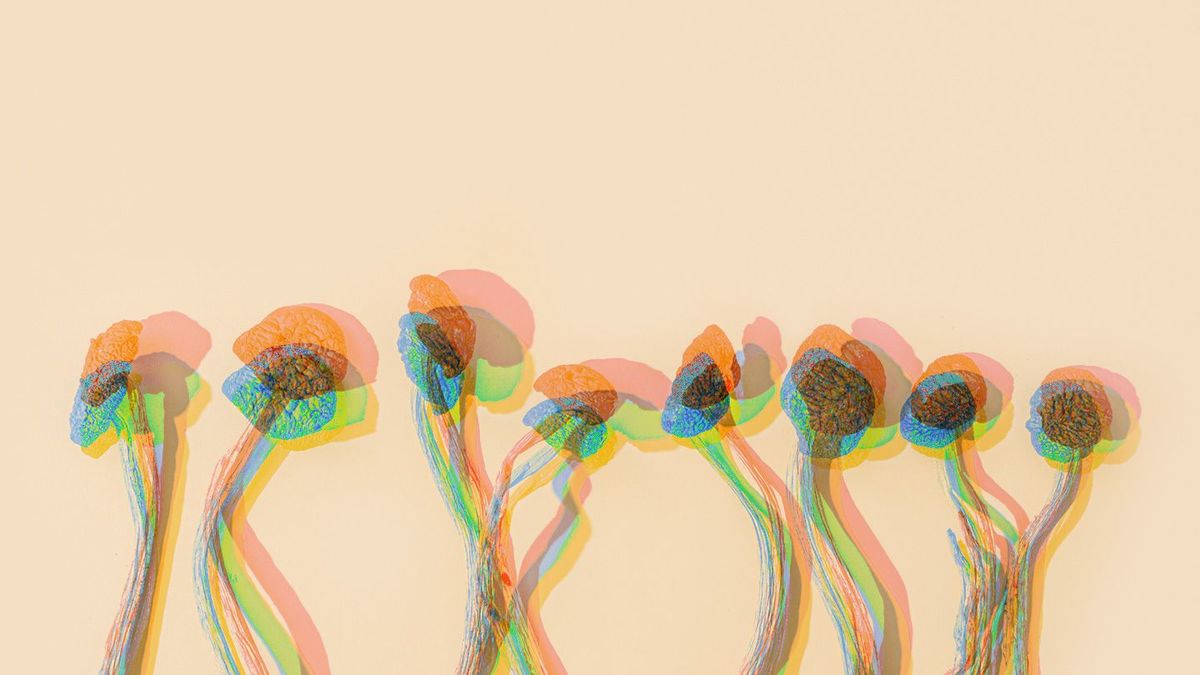
A peer-reviewed 2025 study in npj Aging explored psilocin, the active metabolite of psilocybin, in human cells, and psilocybin in aged mice.
Researchers at Baylor College of Medicine and Emory University used a validated model of cellular aging called replicative senescence, in which human fetal lung fibroblasts are repeatedly divided until they exhaust their capacity to replicate.
The proposed mechanism connects to something called the psilocybin-telomere hypothesis. Telomeres are the protective caps at the ends of chromosomes. The question researchers are asking is whether psilocybin has any relationship to them at all.
This is early experimental work, and it has not been replicated in humans.
Bryan Johnson's self-experiment
Bryan Johnson's self-experiment is not peer-reviewed. He tracked biomarkers around two psilocybin sessions.
We do not follow Bryan's longevity work, and one person's data proves nothing definitive. It is a single data point, worth naming and no more.
Why this matters
This research matters because it asks questions beyond mood or perception, and we hold those questions with curiosity rather than conclusions.
For decades, the conversation around psilocybin has focused almost exclusively on consciousness. The mystical experience. The shift in worldview. Psilocybin is the subject of growing clinical research into mood and wellbeing. The cellular research and biomarker tracking ask about a parallel story, one in the cells, the mitochondria, the inflammatory pathways, the microbial communities of the gut. A story many people who have sat with this medicine sense, even without language for it.
Whether psilocybin extends human lifespan in any meaningful way is far from settled science. The mouse and cellular studies are early. Bryan Johnson is one person. Our view is that there is much we do not yet know, and we would rather stay curious than claim more than the research supports.
The container
If psilocybin does act on the body as well as the mind, then the conditions surrounding ceremony matter even more.
A medicine deserves a body that has been prepared to receive it. Sleep. Nutrition. Hydration. Less stress in the weeks before. The simple things that have always been part of plant medicine preparation are not only spiritual practice. They may also shape how the medicine lands.
At Ananda Lodge, preparation begins weeks before you arrive. This isn't about following rules. It's about giving the medicine, and you, the best possible conditions for the work.
If curiosity is pulling at you
Most people who come to Ananda for their first psilocybin immersion have been thinking about it for a while. They've read articles. They've watched documentaries. They've heard a friend talk about it. Something has been quietly pulling on them, and the conversation around psilocybin and longevity is making the pull a little louder.
If that's where you are, that's worth paying attention to.
We hold psilocybin immersions throughout the year at Ananda Lodge: ten guests on the Empowered Path, 8 to 12 on most specialty immersions. Each includes deep preparation, somatic support, and three months of integration support, so what you see in ceremony becomes how you live. The immersion is not the medicine alone. It is the container around it, and the container is built for follow-through.
See all upcoming immersions
Frequently Asked Questions
Does psilocybin extend lifespan?
That is not known. A 2025 peer-reviewed study in npj Aging explored the question in human cells and aged mice. It is early experimental work and has not been replicated in humans. Psilocybin is the subject of growing clinical research into mood and wellbeing.
What was Bryan Johnson's psilocybin experiment?
In a 2026 self-experiment, Bryan Johnson tracked biomarkers around two psilocybin ceremonies. It is one person's data, it is not peer-reviewed, and it proves nothing definitive.
What is the psilocybin-telomere hypothesis?
The psilocybin-telomere hypothesis is a research question about whether psilocybin has any relationship to telomeres, the protective caps at the ends of chromosomes. The 2025 study in npj Aging explored the idea, and it is early work.
Is psilocybin safe?
Every path begins with an application. Your health history and every medication are reviewed with you at intake. Some health conditions and medications are not compatible with plant medicine. Ceremonies are held by our medicine carriers and guardians in a trauma-informed container.
What does a psilocybin immersion at Ananda Lodge include?
Our psilocybin immersions include multiple ceremonies, deep preparation beginning weeks before arrival, somatic support throughout, and three months of integration support after you leave. The Empowered Path holds ten guests; most specialty immersions hold 8 to 12. The container is built for follow-through.